The Lawyer, the Citation, and the Machine That Never Existed
Late in the evening, a junior attorney at a mid-sized firm ran a complex contract clause through a large language model. The output returned in polished, confident legal prose a citation to a 1998 Delaware Chancery Court ruling that seemed directly on point. The language was impeccable. The syntax was authoritative. The attorney felt reassured.
There was only one problem: the case did not exist. There was no 1998 Delaware Chancery Court ruling matching that description. The model had synthesized a plausible-sounding citation and it had done so in the same flawless language it would have used for a real case. The fluency had done its work. The error arrived dressed for success.
This is not a story about a malfunctioning AI. It is a story about a structural feature of how language models operate and why that feature creates a problem that researchers at GenXis Research have named with clinical precision: the honesty gap.
The anxiety around artificial intelligence is not merely that machines can be wrong. It is that machines can be wrong in fluent, reasonable, socially persuasive language. GenXis Research, "The Honesty Gap: Words Vs. Math"
The honesty gap is not a matter of intent. The model was not trying to deceive. It was doing exactly what it was designed to do: generate language that sounds right. The problem is that sounding right and being right are not the same thing and the gap between them has become one of the defining technical and ethical challenges in applied AI.
What the Honesty Gap Actually Means
In a detailed technical analysis, GenXis Research defines the honesty gap as "the distance between persuasive language and verified truth." The concept emerges from a foundational observation: language is not naturally a carrier of machine-grade certainty.
Natural language is flexible by design. It allows approximation, metaphor, implication, ambiguity, and context dependence. These features make language humanly useful they are why we speak and write rather than exchanging precise mathematical formalisms in everyday communication. But that flexibility is precisely what makes language a weak carrier of verified fact.
The GenXis Research paper formalizes this with a structural definition: "A claim is not merely a sentence. It is a tuple where w is the statement, d is the domain, t is the truth condition, and e is the evidence requirement." Without those elements, language remains expressive but under-bounded it may point toward a reality without specifying the procedure by which that reality is checked.
In plain terms: a sentence can feel precise while remaining logically incomplete. "This was handled responsibly," "the model is aligned," "the evidence supports the claim" each may be true, false, evasive, or meaningless depending on hidden definitions that the sentence itself never specifies. What counts as responsible? Which model? What evidence? The GenXis paper notes that informally, people now use words like vibes and slop to describe language that feels meaningful while carrying weak constraint.
Over time, small verbal deviations compound, the paper argues, "like a singer drifting slightly off pitch until the tonal center is lost." In AI systems, this shows up as hallucination fabricated citations, invented dates, invented book titles, synthesized medical explanations that omit contraindications, financial summaries that rely on stale facts.
Why AI Amplifies the Problem
The honesty gap predates AI. But language models have made it urgently visible in domains where verbal mistakes have real consequences legal drafting, medical triage, education, scientific writing, financial reporting, security analysis, and software development.
The worry is not merely that systems hallucinate. The worry is that hallucinations arrive in the same polished form as true answers. A legal citation can be fabricated in perfect legal prose. A medical explanation can sound clinically plausible while omitting a contraindication. A financial summary can appear authoritative while relying on a fabricated figure.
In each case, the danger comes from the mismatch between linguistic confidence and verified grounding exactly the dynamic the GenXis paper describes: "the danger comes from the mismatch between linguistic confidence and verified grounding."
This is the heart of why AI creates a distinct version of the honesty gap problem. Human communication has always carried this risk a confident speaker can mislead, a polished memo can obscure failure, a reassuring press release can mask decline. But human communication typically operates within social contexts that provide informal verification: reputation, follow-up questions, institutional memory, the ability to ask "how do you know that?"
Language models, by contrast, are designed to be stateless. Each conversation starts fresh. There is no persistent memory of corrections, no accumulated institutional knowledge of what the system got wrong last Tuesday. And the outputs arrive with such fluent, reasonable, socially persuasive language that the cultural heuristics humans use to flag uncertainty hesitation, hedging, incomplete sentences, signs of unfamiliarity are often absent.
The result is an honesty gap that is wider, smoother, and harder to detect than the gaps humans have historically navigated in dealing with other humans.
The Education Parallel That Illuminates the Problem
Here is where the contrarian reading becomes useful. The honesty gap is not only an AI problem. It is a structural feature of any system that relies on flexible language to communicate performance data and one of the most thoroughly documented examples of the honesty gap in action comes not from technology at all, but from American public education.
For more than a decade, education researchers and policy organizations have tracked something they also call the "honesty gap." In that context, it measures the difference between how students perform on the national gold-standard assessment the National Assessment of Educational Progress, known as NAEP or the Nation's Report Card and how they perform on their own state's tests.
The U.S. Chamber of Commerce Foundation, in a 2026 brief produced in partnership with the Collaborative for Student Success, explains the mechanism: "When states lower the bar for proficiency, achievement data can paint a misleading picture one that affects students, parents, educators, and ultimately the workforce."
The gaps can be dramatic. The Chamber Foundation analysis cites data showing that in Iowa, the 2024 state-reported eighth-grade math proficiency rate was 72 percent while NAEP reported only 27 percent proficiency, a 45-percentage-point difference. In Virginia, the 2024 state-reported fourth-grade reading proficiency rate was 73 percent; NAEP reported only 31 percent a 42-percentage-point gap.
The Fordham Institute's commentary on the issue describes the dynamic in similar terms. Dale Chu writes in "Mind the honesty gap" that "as states continue lowering proficiency thresholds, the disconnect between what students are learning and how their progress is reported grows wider." He cites New York, where over half of fourth graders were deemed proficient in math on the state test in 2024, compared to less than 40 percent on NAEP. In Michigan, the gap is even starker: 65 percent of eighth graders were proficient in reading according to the state exam, while just 24 percent cleared the same bar on the nation's report card.
Cory Koedel, an economics professor at the University of Missouri-Columbia writing for the Show-Me Institute, puts the stakes plainly in "The Honesty Gap in Education": "The cognitive skills students learn in school really matter for later-life success, and glossing over declining test scores our best measures of these skills will not change this fundamental fact."
What makes the education example so instructive for understanding AI is the root cause of the gap and the reason it persists despite being widely documented.
The Squishiness Problem, Examined
The GenXis paper identifies the root problem as "the squishiness of words." Language can preserve signal, but it can also metabolize error into something that sounds reasonable. The Fordham Institute commentary makes the same point about education: the problem is not that educators are consciously lying. It is that the flexibility of language and the political incentives surrounding proficiency definitions creates systematic drift between what is reported and what is real.
Koedel articulates this directly in the Show-Me Institute piece: "We seem to have collectively lost our appetite for bad news. Parents don't want to hear that their children are falling behind, and schools are reluctant to deliver that message. Meanwhile, states face little pushback when they lower testing standards and inflate proficiency rates."
This is structurally identical to what happens inside language models. The system is not trying to deceive it is optimizing for fluency, coherence, and helpfulness, which are the incentives it was trained on. But the result is the same kind of systematic drift: outputs that sound confident, reasonable, and responsible while diverging from verified ground truth.
The education case also demonstrates something important about how honesty gaps close. The Collaborative for Student Success, in its 2026 analysis, notes that Massachusetts and Rhode Island have closed their gaps to within five percentage points or less across both grades and subjects. Fourteen states are now holding students to an equal or higher standard than NAEP in at least one grade or subject.
The pattern is not accidental. States that have aligned their standards with national benchmarks and held those standards consistently have narrower honesty gaps. This is the empirical record. The gap does not close through good intentions or aspirational language. It closes through structural alignment with verifiable external benchmarks.
Jim Cowen, Executive Director of the Collaborative for Student Success, frames it this way in the Chamber Foundation brief: "To be clear, improving student outcomes takes huge commitments from states on efforts like high quality curriculum, strong teacher development and student supports. But the truth matters. We salute the states that are embracing the issue rather than masking it or running away from it."
Why This Matters for GenXis Research Readers
If you are evaluating AI systems for deployment in any domain where errors carry consequences legal, medical, financial, scientific, operational the education parallel is not merely an analogy. It is a structural warning.
The same dynamics that allowed state proficiency standards to drift from national benchmarks are active inside language models: flexible language that can rationalize and blur, incentives that reward fluency over precision, and the absence of systematic external verification. The GenXis Research framework names these dynamics explicitly and offers a vocabulary for thinking about them rigorously.
The practical implication is direct: organizations cannot rely on the linguistic confidence of AI outputs as evidence of their accuracy. Confidence and correctness are not the same signal. The fluency of a model its ability to produce smooth, reasonable, authoritative text tells you nothing about whether the content can be verified against a mathematical ground truth or an external evidence standard.
This does not mean AI systems are untrustworthy. It means that trust in AI must be architecturally grounded built on verification pathways, source custody, deterministic checks, and calibrated abstention rather than assumed on the basis of fluent output.
The Path Forward: Verification Anchors
The GenXis Research analysis does not counsel abandoning language. It counsels stronger grounding: "The antidote is not less language, but stronger grounding: mathematical constraint, source custody, deterministic checks, calibrated abstention, and evidence memory."
This framing is worth sitting with. The instinct when confronting AI errors might be to demand more hedging, more caveats, more cautious language from models. But cautious language is still squishy language. A model that says "I am not certain, but..." and then proceeds to generate a confident, detailed, plausible-sounding explanation is not solving the honesty gap it is dressing it in different clothes.
The path forward is not more careful language. It is language that is anchored to verifiable procedures: mathematical constraints that specify truth conditions, source custody that tracks where information came from, deterministic checks that verify outputs against external data, and calibrated abstention the willingness to say "I do not know" rather than generating a confident fabrication.
This is structurally identical to what the education policy examples show: gaps close when standards align with external benchmarks, not when rhetoric improves.
Distinguishing Hallucination from Dishonesty
A question that often arises in discussions of AI errors is whether hallucinations constitute a form of dishonesty. The GenXis framework offers a precise answer: no, not in the traditional sense of the term.
Dishonesty implies intent a deliberate choice to communicate something the speaker knows to be false. Hallucination, in the AI context, is a different phenomenon: it is the generation of fluent, plausible content that cannot be verified against ground truth, produced by a system that has no mechanism for knowing whether what it is saying is correct.
This distinction matters for remediation. You cannot solve the hallucination problem by punishing the model for lying, because the model is not lying in any meaningful sense. You solve it by building verification infrastructure source custody, mathematical grounding, evidence chains that gives the system a way to know what it does not know.
Koedel's analysis of the education honesty gap makes the same point in a different domain. The problem is not that educators are consciously dishonest. It is that the system they operate in has "collectively lost our appetite for bad news," leading to standards drift that is structural rather than individual. The solution is not scolding or blame it is realignment with external benchmarks.
The Common Denominator Across Domains
What connects the AI honesty gap and the education honesty gap is the observation that flexible language, operating without strong verification anchors, will drift. It will compound. It will metabolize small deviations into larger gaps over time, until the tonal center is lost until "proficient" means something fundamentally different from what the national benchmark measures, or until a confident AI answer bears no discoverable relationship to fact.
The drift is not evil. It is entropic. It is what happens when language operates without an external reference point.
The intervention is the same in both domains: mathematical constraint, external verification, and a willingness to measure against a standard rather than a feeling. In education, this meant aligning state assessments with NAEP. In AI, it means building language models that can produce evidence chains, cite sources with custody, and abstain from generating content that cannot be verified.
This is not a pessimistic prediction about AI. It is an optimistic engineering challenge. The honesty gap is not an intractable feature of intelligence artificial or human. It is a calibration problem, and calibration problems have solutions.
Where to Read Further
For a rigorous technical framing of the honesty gap concept as applied to AI language models, the GenXis Research paper "The Honesty Gap: Words Vs. Math" provides the foundational definition and framework.
For the education policy parallel documenting how the same dynamic has played out in K-12 academic standards and proficiency reporting the U.S. Chamber of Commerce Foundation's April 2026 Honesty Gap brief offers state-by-state data and analysis.
The Collaborative for Student Success Honesty Gap analysis provides the most recent comparative data between state proficiency rates and NAEP benchmarks, with particular attention to the gap's geographic distribution and trajectory over time.
For a policy commentary on why the education honesty gap persists and what it would take to close it structurally, Dale Chu's "Mind the honesty gap" at the Thomas B. Fordham Institute traces the history of the problem from the Proficiency Illusion report through the post-pandemic widening of the gap.
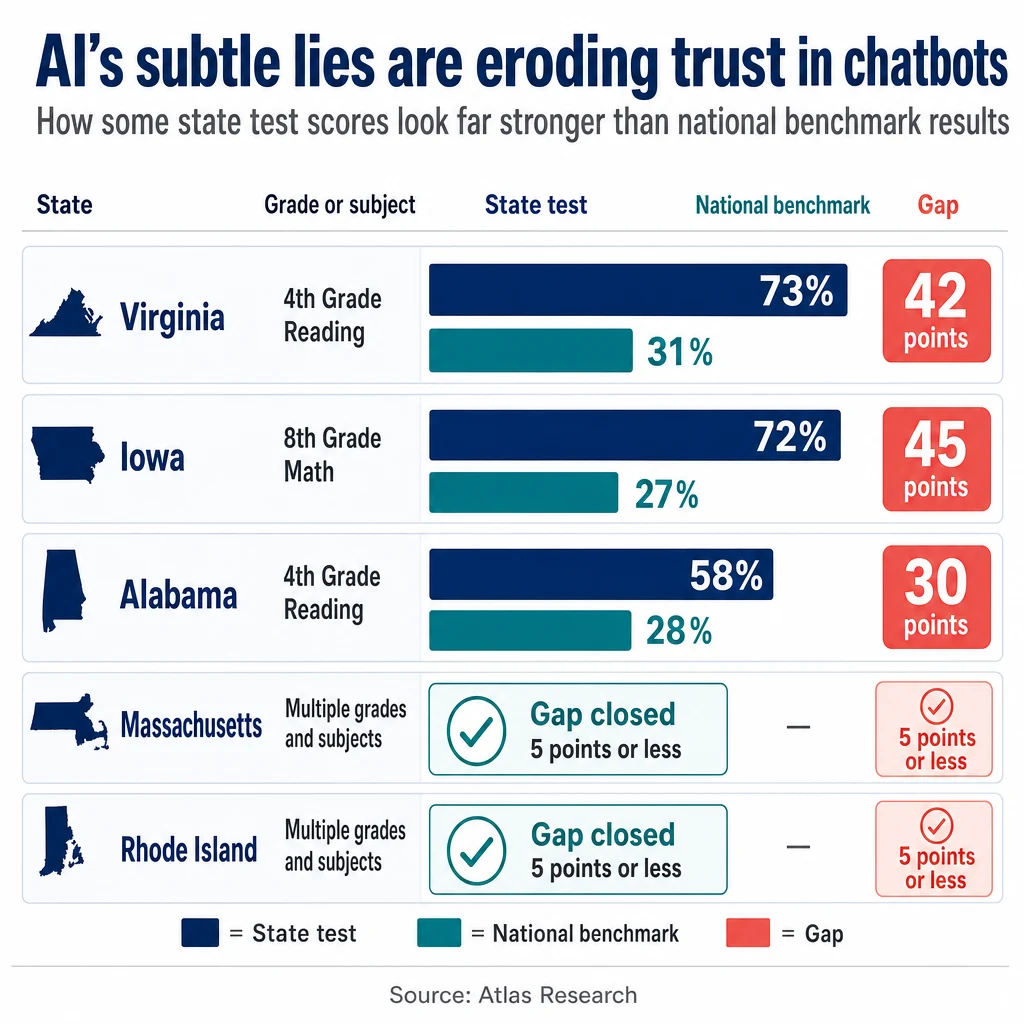
| State | Grade / Subject | State Test Proficiency | NAEP Proficiency | Gap (percentage points) |
|---|---|---|---|---|
| Virginia | 4th Grade Reading | 73% | 31% | 42 |
| Iowa | 8th Grade Math | 72% | 27% | 45 |
| Alabama | 4th Grade Reading | 58% | 28% | 30 |
| Massachusetts | Multiple grades/subjects | Within 5 pts of NAEP | ≤5 (gap closed) | |
| Rhode Island | Multiple grades/subjects | Within 5 pts of NAEP | ≤5 (gap closed) |
Selected state-by-state honesty gap data from 2024, comparing state-reported proficiency rates to NAEP national benchmarks. Sources: U.S. Chamber of Commerce Foundation (April 2026); Collaborative for Student Success Honesty Gap Analysis (2026).
FAQ
What is the honesty gap in AI?
The honesty gap is the distance between how confidently and fluently an AI system communicates and whether its outputs can be verified against a mathematical or empirical ground truth. The GenXis Research framework defines it as the gap between persuasive language and verified truth a structural feature of how language models operate, not a deliberate design choice or malfunction.
Why do AI systems struggle with honesty?
AI language models are trained to generate fluent, coherent, helpful text not to verify that text against external facts. Natural language is inherently flexible and can preserve signal or metabolize error into something that sounds reasonable. Without mathematical constraint, source custody, and deterministic verification, models will produce outputs that sound confident while drifting from truth. This is not dishonesty in the intentional sense; it is a calibration problem created by the absence of verification infrastructure.
What is the difference between AI hallucination and dishonesty?
Hallucination refers to the generation of confident, plausible-sounding content fabricated citations, invented facts, invented dates that cannot be verified against ground truth. Dishonesty implies deliberate intent to mislead. Hallucination is neither intentional nor moral in the traditional sense; it is an output generated by a system that has no mechanism for knowing whether the content is correct. The remediation for hallucination is not blame but verification architecture.
How can organizations bridge the AI honesty gap?
Organizations can bridge the honesty gap by building verification infrastructure into their AI workflows: requiring source custody (citations with verified origins), implementing deterministic checks against external data, using mathematical constraint where outputs can be formally verified, and implementing calibrated abstention systems that decline to generate content when verification is not possible rather than fabricating a plausible answer. The goal is not less language from AI, but language anchored to verification pathways.
How does the education honesty gap compare to the AI honesty gap?
The structural dynamics are nearly identical. In education, state proficiency standards diverged from national NAEP benchmarks when political incentives rewarded leniency over accuracy producing systematic gaps between reported performance and actual student mastery. In AI, language model incentives reward fluency and helpfulness, producing outputs that can be confident and persuasive while diverging from fact. Both gaps close through the same mechanism: alignment with external, verifiable benchmarks rather than reliance on the internal confidence of the reporting system.